Topics:

Programs & Services

The Office of the State Long-Term Care Ombudsman offers free, confidential advocacy for Iowans living in nursing facilities, assisted living programs, residential care facilities, and elder group homes. We’re here to help residents and families understand their rights and address concerns about long-term care. 

We also assist Medicaid managed care members who live in a long-term care facility or receive services through an HCBS waiver, making sure they understand their rights and receive the services they need. 

Our team listens, looks into concerns when needed, and works with facilities to ensure every resident is treated with dignity and respect. If you’re unsure where to start or have a question, we’re here to help. 

You can reach us through our  online form or by contacting us directly.  

Toll-Free: 866-236-1430  
Email: sltco@hhs.iowa.gov  
Mailing Address: 321 E. 12th St., 2nd Floor, Des Moines, IA 50319

Get Help Now— What do you need today? 

Volunteer With Us - Change lives including yours

Education and Resources - Learn, connect and get involved

Back to top

Quick Help - What Do You Need Today?

  • Find local support → Connect with your regional Ombudsman. 

  • Know your rights → Clear, easy-to-read guides. 

  • Involuntary discharge help → Understand notices and appeal steps.

  • Facility closure→ What to expect and how we can help.

How we Help - Real Help, from Real People

Back to top

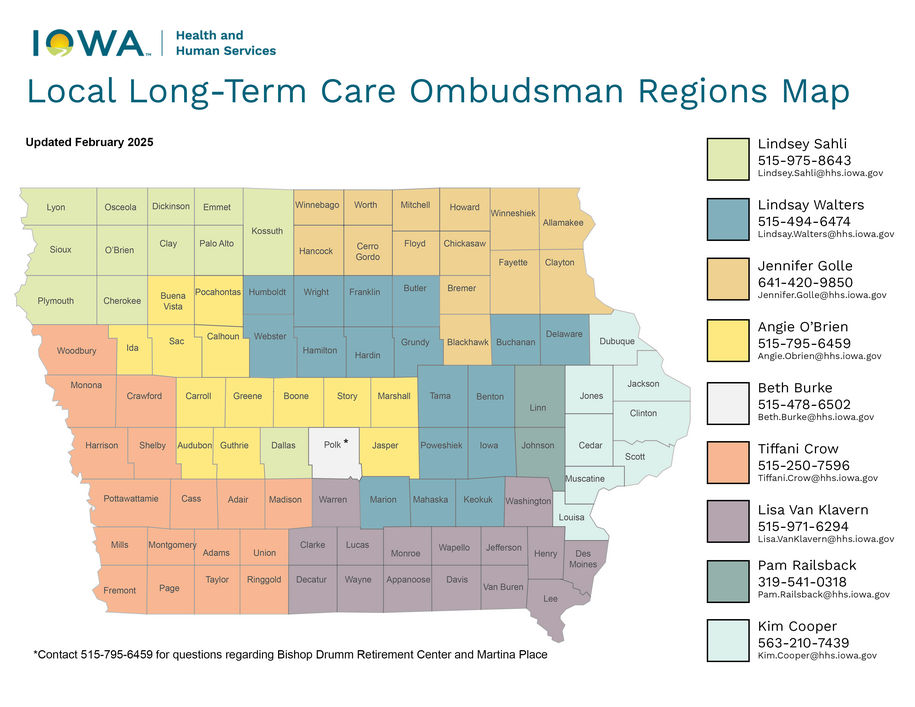
Local Ombudsman - Your Local Ombudsman is Ready to Help - Find Them Here

A long-term care ombudsman makes sure your voice is heard. We listen to concerns, help solve problems, and protect the rights of people living in long-term care or receiving HCBS waiver services. 

Toll-Free 866.236.1430  
Email: sltco@hhs.iowa.gov  

Ombudsman - Internal Map - Feb 2025.png

Long-Term Care Ombudsmen help residents and their families address concerns, understand their options, and protect their rights. If something feels off—or you just need guidance—we’re here to support you. 

  • We listen and help you decide next steps. 

  • We look into concerns and work toward solutions 

  •  We advocate for dignity, respect, and quality of life. 

You can contact the OSLTCO if you want to: 

• Get help with concerns, care issues, or involuntary discharges/closures  
• Understand rights, facility policies, rules, or managed care processes  
• Learn about care plans, services, transfers, or discharges  
• Get guidance on power of attorney, guardians, or conservators  
• Learn about Resident or Family Councils  
• Get assistance with Medicaid managed care issues  
• Find information to help choose a long-term care facility or managed care organization 

You can also learn more by viewing our LTC Ombudsman Brochure, Resident Rights Brochure, and our informational Ombudsman Video and Resident Rights Video

Back to top

Transfers, Discharges and Facility Closures

Residents have important rights during transfers or discharges. This includes receiving written notice and having the opportunity to appeal. Facilities may only issue a discharge for specific reasons, such as medical needs they cannot meet, safety concerns, nonpayment, certain policy issues, or a facility closure. If you receive a notice—or are concerned about a possible move—contact us. We can explain your rights and help you determine next steps. Learn more about involuntary discharges with the Involuntary Discharge Brochure 

If a facility closes, we support residents and families throughout the transition. We assist with planning, understanding rights, selecting a new placement, and coordinating with the facility to help ensure the move is as safe and smooth as possible. For more guidance on what to expect during a closure, view the Facility Closure Brochure and Facility Closure Video

Back to top

Volunteer - Change Lives, Including Yours!

Volunteers make a real difference in the lives of long-term care residents. By visiting facilities, listening to residents, and supporting advocacy and community education, volunteers help ensure every resident’s voice is heard. We provide full training and ongoing support, making it easy to get started. 

Interested in volunteering? Download the application, or email sltco@hhs.iowa.gov if you have questions or want more information.  

Back to top

Education and Resources - Learn, Connect and Get Involved

Town hall meetings are public, recorded, and posted on our website. Because these meetings are open to the public, please keep that in mind when deciding whether to share personal information. If you have concerns about the public nature of these meetings or what may be shared, please reach out to the Office of the State Long-Term Care Ombudsman—we’re happy to talk with you.   

Back to top

Understanding Long-term Care Ombudsman Services

This video covers issues that the Long-Term Care Ombudsman can help address:

This video covers the rights that Long-Term Care residents have:

Back to top

Volunteer Opportunities

Volunteers are an important part of the work of the OSLTCO and may carry out visits, administrative tasks, or other special projects.  Some individuals living in long-term care facilities have little or no outside support from family or friends.  A volunteer ombudsman who visits regularly can brighten a resident’s day and help ensure care is delivered in a respectful, dignified manner to meet an individual’s needs. 

Anyone who is passionate about helping others, has a caring nature, and is eager to learn is encouraged to apply!  Reach out to the OSLTCO at sltco@hhs.iowa.gov to receive an application or click the link below.  We offer volunteers comprehensive training, resources, and continuous support. 

If you're interested, please reach out to sltco@hhs.iowa.gov to receive an application. 

Back to top

Annual Reports

Back to top

Town Halls

Town hall meetings are public, recorded, and will be shared on our website. Please be cognizant of the public nature of these meetings in determining whether to share personal details or information.  If there are specific concerns about the public nature of these meetings or information shared during these meetings, please reach out to the Office of the State Long-Term Care Ombudsman. 

October 2024: Personal Needs Allowance 

Personal Needs Allowance (PNA) is the amount of monthly income an individual on Medicaid who resides in a nursing facility can keep.  This town hall discusses PNA in Iowa and a resident-led initiative to increase the amount, which was last increased to $50 in 2001. 

November 2024: Family Council

Family councils are an organized, self-led group of families and resident representatives who meet regularly to help support and advocate for resident rights to improve quality of life and care and communicate suggestions and collective concerns to facility staff for the betterment of residents.  This town hall talks all things family councils, offering ideas for a successful family council, with the goal of increasing the number of active family councils in our state. 

December 2024: Visiting During the Holidays 

Celebrating and being present with those who live in a long-term care facility is so important for overall well-being, during the holidays and every day of the year.  This town hall includes a conversation regarding visitation, to include resident rights, how to involve residents and tenants during the holiday season, and how to help keep everyone healthy during a busy, joyful time of year. 

February 2025:  Personal Needs Allowance (PNA) Updates

Personal Needs Allowance (PNA) is the amount of monthly income an individual on Medicaid who resides in a nursing facility can keep. Currently, in Iowa, this amount is $50 per month.  This town hall builds off our October 2024 town hall, discussing PNA updates in Iowa and the resident-led initiative to increase the amount to $65 with an annual cost of living adjustment (COLA).

June 2025:  About the OSLTCO and What is a Long-Term Care Ombudsman Anyway?  

The Office of the State Long-Term Care Ombudsman (OSLTCO) invites you to join our June town hall, where we will talk about our office and what a long-term care ombudsman does.  We often hear that people aren’t sure how to pronounce “ombudsman,” let alone understand our role. Many tell us they wish they’d known about our services sooner—especially during critical moments or when they had questions and needed support.

September 2025: Family Council Updates

Family councils can be described as organized, self-led groups of families and resident representatives who meet regularly to help support and advocate for quality of life and care for individuals in long-term care. September's town hall is a follow up, where there is again discussion about family councils, providing an update on work being done in this area and why it is important to have family, loved ones, and community involved and serving as a voice for residents. 

December 2025: Addressing Common Issues in Long-Term Care:  A Conversation with OSLTCO Staff

Every year, the Office of the State Long-Term Care Ombudsman (OSLTCO) team works to resolve a variety of complaints brought forward by or on behalf of residents in long-term care facilities.  This town hall includes an overview of top complaints received by long-term care ombudsman programs in Iowa and nationwide and focuses on conversation with Iowa's local long-term care ombudsmen about common issues they help address.  Learn what those common issues are, what the regulations say, and what can be done for successful complaint resolution from Iowa's local ombudsmen who advocate every day to uphold quality of care and quality of life for those in long-term care facilities.

March 2026: Systems Advocacy: Together, We Can!

Back to top

Resident and Family Councils 

Resident and Family Councils offer a private space for individuals residing in long-term care and those who support them to share concerns, ideas, and suggestions to improve quality of life and care. Councils foster community, encourage open communication, and empower members to speak up, engage with staff, and influence change towards a more person-centered culture within a facility. 

The Omnibus Budget Reconciliation Act of 1987 (OBRA ‘87), also known as the Nursing Home Reform Law, included landmark federal legislation that guaranteed certain rights for individuals living in nursing homes.  One of those rights included the right to form and meet in resident and family groups, also known as councils. 

Resident Councils 

Resident councils are an organized, resident-led group of individuals who live in a long-term care facility and come together to represent the voice of residents. The resident council offers a platform to discuss common concerns, organize social events, and collaborate with administration to improve the overall quality of care and life for those who live in long-term care facilities. 

Family Councils 

Family councils are an organized, self-led group of families and representatives of individuals living in long-term care.  They: 

  • Meet regularly to help ensure rights are upheld and needs are met.
  • Communicate, act, support, and provide education to improve the quality of life and care of individuals living in nursing facilities.
  • Discuss and offer suggestions and bring collective concerns to facility staff for the betterment of individuals living in long-term care facilities.
  • Empower your voice! Use Family Councils: Making an Impact (4.35 MB) .pdf to start or join a family council and create positive change in your loved one’s long-term care community.

Regulations that Support Resident and Family Councils 

Federal regulations support the development and support of resident and family councils in nursing facilities.  Specifically, the Code of Federal Regulations (CFR) 483.10(f)(5) states: 

  • The facility must provide a resident or family group, if one exists, with private space; and take reasonable steps, with the approval of the group, to make residents and family members aware of upcoming meetings in a timely manner.
  • Residents have the right to participate in family groups.
  • Residents have the right to have family members or other resident representative(s) meet in the facility with family or representatives of other individuals living in the facility.
  • Staff, visitors, or other guests may attend resident or family group meetings only at the group’s invitation. 

Iowa Administrative Code 481-67.3(6), specific to assisted living programs, supports the right for tenants to associate and communicate privately and without restriction with persons and groups of the tenant’s choice, including the tenant advocate, on the tenant’s initiative or on the initiative of the persons or groups at any reasonable hour.   

Iowa Administrative Code 481-67.3(8) also states tenants have the right to present grievances and recommend changes in program policies and services, personally or through other persons or in combination with others, to the program’s staff or person in charge without fear of reprisal, restraint, interference, coercion, or discrimination. 

Iowa’s Virtual Resident and Family Council Support Meeting 

In 2025, the Office of the State Long-Term Care Ombudsman (OSLTCO) began hosting Resident and Family Council Support Meetings with goals to: 

  • Connect people who live in or have loved ones in long-term care,
  • Educate on the issues experienced in the long-term care system, and
  • Share ideas and empower attendees to resolve concerns and improve quality of life for individuals in Iowa’s long-term care facilities.  

The OSLTCO hosts this virtual meeting on Zoom the last Wednesday of every other month from 2:30 p.m. - 3:30 p.m. CST.  Anyone living in a long-term care facility (nursing facility, assisted living, residential care facility) and/or those who have a loved one in a facility are welcome to join.  Advance registration is required. Contact the OSLTCO at sltco@hhs.iowa.gov or 1-866-236-1430 to receive the registration link. After registering, a confirmation email will be sent containing information about how to join the meeting.  These support meetings are recorded and will be shared on our website. Please be cognizant in determining whether to share personal details or information.  If there are specific concerns about the posting of these meetings or information shared during these meetings, please reach out to the Office of the State Long-Term Care Ombudsman.   

June 2025

July 2025

August 2025

September 2025

November 2025

January 2026

March 2026

May 2026

High Five Topics 

Our High Fives are easy-to-read, easy-to-understand topics shared at every support meeting that provide 5 helpful tips for resident and family councils.  These strategies can help individuals better self-advocate and feel empowered to speak up about their or their loved one's care. 

June 2025: 5 Reasons Resident and Family Councils should exist in every facility (283.07 KB) .pdf

July 2025: 5 Ways to Solicit a Better Response from Facility or Program Staff (281.23 KB) .pdf

August 2025: 5 Ways you can Respond when a Facility is Not Responsive to the Council (107.69 KB) .pdf

September 2025: 5 ways You Can Show Appreciation to Long-Term Care Facility Staff (253.97 KB) .pdf

November 2025: 5 Tips to Support Systems Advocacy (160.62 KB) .pdf

January 2026: 5 Things Every Person who Moves into a Facility Should Know (171.96 KB) .pdf

March 2026: 5 Things to Know About Iowa's Office of the State Long-Term Care Ombudsman (234.45 KB) .pdf

May 2026: 5 Signs a Long-Term Care Facility Values Person-Centered Car (240.24 KB) .pdf

Back to top

Involuntary Discharges

State and federal laws outline the rights of individuals who live in long-term care facilities.  Included in these rights is the right to appeal a decision if asked to involuntarily transfer or discharge from a facility.  For information about the rules, resident rights, or to request assistance, contact the Office of the State Long-Term Care Ombudsman (OSLTCO) at 1-866-236-1430, or email: sltco@hhs.iowa.gov   

Learn more about involuntary discharges with the Involuntary Discharge Brochure . (2.6 MB) .pdf

Nursing Facility Involuntary Discharge

An involuntary discharge from a Nursing Facility occurs when the facility provides a 30-day written notice to a resident informing him/her of the need to move out of the facility. Under Federal regulation 42 CFR 483.15(c), State Operations Manual - Appendix PP, and Iowa Administrative Code 481-58.40(135C), a facility must permit residents to remain in a facility and not discharge them unless: 

  • There is a medical reason as determined and documented by the resident’s primary care provider,
  • The resident's behavior poses a threat to themselves or to the well-being of other residents or staff;   
  • There is nonpayment for the resident’s stay;
  • Due to action pursuant to Iowa code chapter 229;
  • By reason of negative action by the Iowa Department of Health and Human Services; or
  • By reason of negative action by the quality improvement organization (QIO).
  • Residents have the right to appeal an involuntary discharge within seven (7) days of receiving the notice.   

Assisted Living Program Involuntary Transfer

A transfer from an Assisted Living Program may occur due to the following criteria as outlined within Iowa Administrative Code 481-69.23(231C).  

A program may not knowingly admit or retain a tenant who: 

  • Is bed-bound; or
  • Requires routine, two-person assistance with standing, transfer or evacuation; or
  • Is dangerous to self or other tenants or staff, including but not limited to a tenant who:
  • (1) Despite intervention chronically elopes, is sexually or physically aggressive or abusive, or displays unmanageable verbal abuse or aggression; or
  • (2) Displays behavior that places another tenant at risk; or
  • Is in an acute stage of alcoholism, drug addiction, or uncontrolled mental illness; or
  • Is under the age of 18; or
  • Requires more than part-time or intermittent health-related care; or
  • Has unmanageable incontinence on a routine basis despite an individualized toileting program;
  • Is medically unstable;
  • Requires maximal assistance with activities of daily living; or
  • Despite intervention, chronically urinates or defecates in places that are not considered acceptable according to societal norms, such as on the floor or in a potted plant.
  • Additional transfer criteria may be disclosed in the written occupancy agreement.  If an Assisted Living Program initiates the transfer process, the tenant or their legal representative shall be notified in accordance with the occupancy agreement.  The program is obligated to follow their internal appeal process if the tenant or their legal representative wish to appeal this decision. 

Iowa Administrative Code 481.69.24(231C) outlines rules for involuntary transfer from an assisted living program."

Residential Care Facility Involuntary Discharge

  • An involuntary discharge from a Residential Care Facility occurs when the facility provides a 30-day written notice to a resident informing him/her of the need to move out of the facility. Under Iowa Administrative Code 481-57.40(135C), a facility must permit residents to remain in a facility and not discharge them unless:
  • There is a medical reason as determined and documented by the resident’s primary care provider,
  • The resident's behavior poses a threat to themselves or to the well-being of other residents or staff;   
  • There is a repeated refusal by the resident to participate in their service plan.
  • There is nonpayment for the resident’s stay; or due to action pursuant to Iowa Code chapter 229.
  • Residents have the right to appeal an involuntary discharge within seven (7) days of receiving the notice. 
Back to top

Monthly Facility Transfer/Discharge Notification 

This video covers the actions that you can take when you are facing a discharge from the facility:

Back to top

Facility Closure

Learning about a facility closure can be very stressful for everyone involved.  The OSLTCO is actively involved during facility closures and will offer support and advocacy to all residents throughout the closure process. 

By having discussions in advance with the facility and legal representatives and by being better informed about resident rights and facility responsibilities, transfer trauma may be able to be minimized, and residents may be better prepared for sudden or unexpected closures.    

Download the Facility Closure Brochure (1.46 MB) .pdf .

Facility Closure Video

This six-minute informational video provides in depth details to outline the specifics of how to self-advocate, how to prepare for a move and uphold resident rights during the closure process:  Facility Closure   

Back to top

Resources

This video highlights what qualifies as Elder Abuse and what steps you can take if you feel abuse is happening:

Back to top

Additional Resources

Back to top